The Eisenhower decision matrix is a useful framework, but it will need to be rethought for the age of AI. The matrix is essentially a tool for deciding whether to do, schedule, delegate, or delete a specific task.
Here is what it looks like:
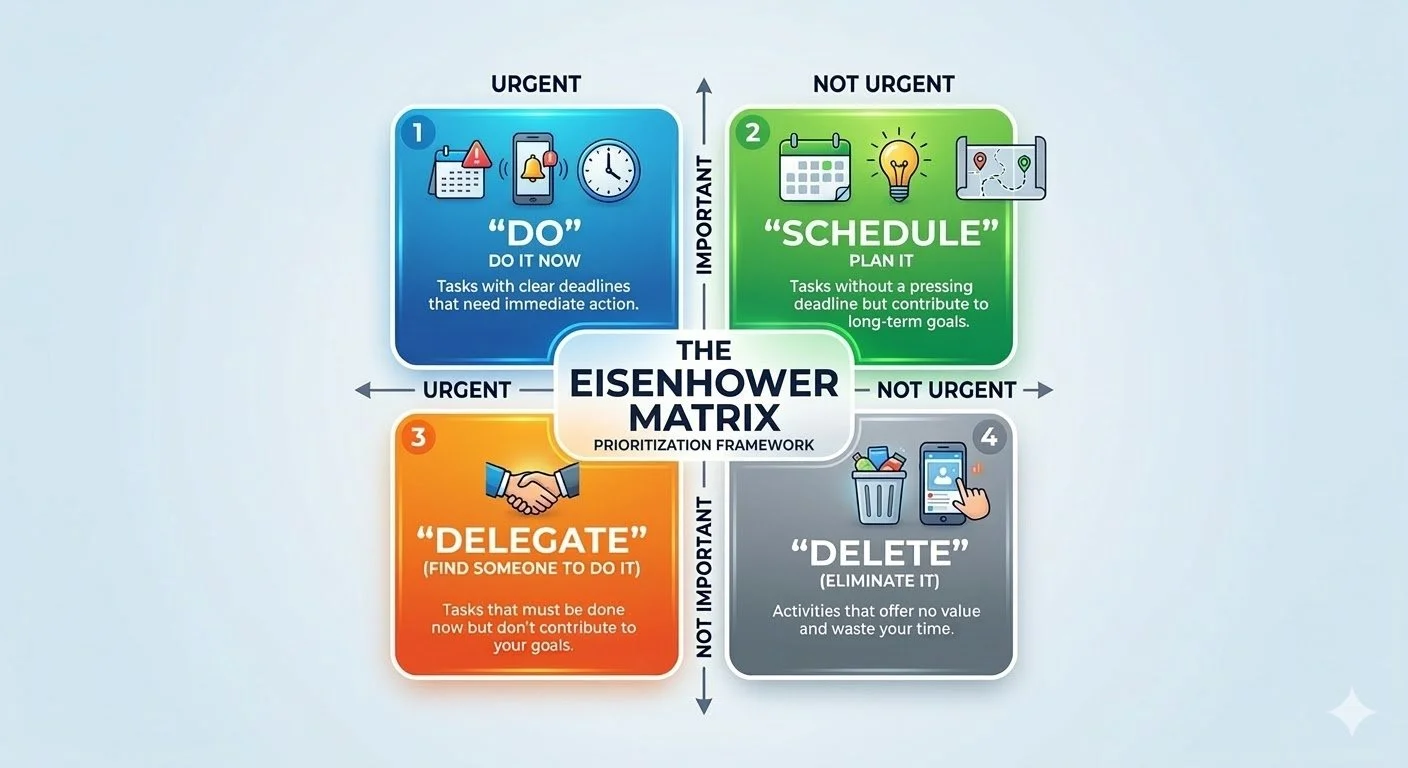
Note: this image was created using Gemini
Certainly, the matrix is simplistic: it assumes you can clearly distinguish urgency and importance. Yet, despite these flaws, it remains interesting—but must be rethought in light of AI.
The idea for the post was inspired by a news article that said hiring teams are being inundated with piles of AI-generated CVs and cover letters. So what are they doing to “fix” the problem? They are using their own AI to sift through the mound. The same thing is happening with interviews. Applicants are using AI to assist them with interviews (e.g., by providing answers), and hiring teams are now using AI to conduct interviews. So you are essentially just chatting with a deepfake, which is screening you based on the keywords you use.
This game of cat and mouse is going nowhere. Hiring folks are being overwhelmed, and applicants are being forced to jump through hoops in the hopes of getting a job.
This isn’t the only example of AI against AI, resulting in us losing the human element and not really accomplishing the desired end state. The same goes for many generative AI outputs. Email is easier than ever with AI, so people are sending more messages, and the recipients are now using their own AI to parse through messages. Because of all the emails swirling around, people feel highly productive, but little has changed toward the desired outcome (e.g., profit or better services). I don’t know if you have ever had to deal with an AI help desk employee, but I immediately asked repeatedly for a human, only to be stuck in a never-ending AI loop.
That said, this does not mean AI is not useful. It genuinely has the potential to help with many things (and is already helping with some tasks). This is why I am suggesting we rethink the Eisenhower matrix. The main element I am suggesting we rethink is the delegate quadrant. Prior to AI, many people were delegating to real people, and some still are, but many aren’t. Instead, they are turning to AI to get the task done for them. Especially with agentic AI, the temptation to delegate everything is alluring. I argue that this delegation quadrant should be seriously reconsidered, and when in doubt, instead of delegating to AI, consider deleting the task. I can’t imagine anything truly urgent but not important that's worth anyone’s time.
So whenever you face a decision of what to do with a specific task. Ask yourself whether you should do it now, decide when to do it later, and if you are really tempted to delegate it to an AI or someone, consider whether it is helping you towards your desired state. Not just the end state of the project, but whether the entire project is worth it for whatever your bottom line is. Is it monetary — then does automating it make you money? If not, we risk automating processes that only distract you from your end objective. And the most dangerous part is that it feels productive.
How might rethinking the delegation quadrant of the Eisenhower matrix influence your own approach to prioritizing tasks in the age of AI?
Take care,
Emanuel